archived:10.5281/zenodo.17443705
Latent and Bound
~ Meaning That Waits
I want to put something between two blocks of text that does not mean anything … yet.
At the core of every formal language, from mathematics to code, lies a mechanism: opposing pairs. Two poles that span the space between them.
Some of these pairs are irreducible: logic's atoms that cannot be reduced further, from which all representation must be built.
Within formal systems, we rely on three such pairs:
- True/False – the axis of logic
- Defined/Undefined – the axis of existence
- Null/Value – the axis of content
Together, these three pairs answer: Is it true? Does it exist? Does it have content?
Some things, however, slip between.
The nature of waiting
If time can wait, can meaning?
Consider a vote that has been cast but not yet counted[1]. It is neither undefined nor null: it carries structure and intent, but awaits the context that determines its meaning. Who counts it, and under which rule, is not yet settled. The vessel is prepared, but what it will contain depends on conditions not yet met.
What waits shows two poles: held in dormant readiness, or bound in a fulfilled context. In this work, we call them Latent/Bound[3]. The word is borrowed from photography[2]. Unlike undefined or null, the latent is semantically prepared and awaits a context in order to become bound. A legal document signed but not witnessed is latent in the same way: complete in form, incomplete in realization, until the witness supplies what the signature alone cannot.
If it waits to become something, does it already carry meaning, or is it still only absence?
To name what waits, we must make it visible.
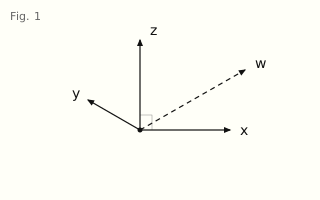
The first three pairs describe states of logic, existence, and content; Latent/Bound describes a status that shifts with context.
|
|
This essay proposes a fourth semantic pair[4], orthogonal[5] to the other three. Where null denotes absence of content, latent denotes a rest before presence: a prepared contract (the method of interpretation, HOW) awaiting its context. A latent symbol is itself defined and carries a contract; what it rests on may be true or false, what its condition names may be defined or undefined, and what it holds may be null or a value. None of that settles whether it has bound.
In the comparisons below, the three established pairs describe what the symbol carries or refers to: a proposition, an expression, or a content field. The symbol itself is defined and carries a contract. Along each of those axes both values occur with both binding statuses. That is what orthogonal means here, and it can be shown cell by cell.
| Latent | Bound | |
|---|---|---|
| True / False of the proposition the act rests on |
A ballot from an eligible voter, not yet counted (true). A ballot from a voter who wrongly believes they are eligible, not yet counted (false). Both wait; neither is counted. | A report “the room holds twenty” recorded as available information, and accurate (true). The same report recorded, later found wrong (false). The record stands either way; its truth does not decide its binding. |
| Defined / Undefined of an expression referenced by the contract |
A vote waiting for a witness under a stated quorum rule (defined). A proposal whose window rule refers to a procedure the group has not adopted; the condition cannot be evaluated, and the ledger holds that as its ground (undefined). | A mandate granted and accepted under a rule with a stated term (defined). A role bound under a fully specified acceptance rule, while an expression governing its later expiry remains undefined; it is in force, and what its expiry means is not yet settled. |
| Null / Value of a field in the content |
A proposal awaiting the close of a veto window, with its deadline field null because the deadline is supplied by a shared rule (null). The same proposal with its own deadline (value). Both latent until the window closes. | An identity claim accepted on a handle alone, with no key on file (null). The same claim accepted after a key was checked (value). Both bound; what differs is the ground the ledger holds. |
Every cell is occupied. These examples show that truth, definedness, and the presence of a value do not, by themselves, determine binding status. Binding concerns whether an occurrence’s effect has been established under the applicable procedure. Truth is a relation between a proposition and the world, definedness between an expression and its evaluation, content between a place and what fills it. Binding is a relation between an act and a procedure. That is why it cannot be read off the other three.
Zero provides a limited analogy: a position contributes nothing, yet it is explicitly represented and participates in calculation. Likewise, a latent symbol has no bound effect, but remains recorded with its conditions and available for evaluation. Unlike zero, latency leaves open whether an effect will ever be established.
What Latent/Bound is not
For readers versed in programming language theory, this may sound familiar. The distinction is subtle, and important.
- Thunks defer computation via closures, yet the computation itself is already predefined
- First-class continuations capture control-flow state, not semantic interpretation
- Monadic effects defer side effects in pure languages, yet the effect type is known at design time
- Lazy evaluation defers when the computation runs, not what is determined
- Promises/Futures defer data arrival, not semantic resolution
- Dispatch defers which implementation runs, not which meaning is bound
- Rule engines activate conditions in context, but the meaning is predetermined
- Algebraic effects declare that effects occur and defer handling, not the interpretive contract
Unlike all of the mechanisms above, we do not defer when but what: not the time of the outcome, but the semantics themselves that are to be bound.
The distinction is named. What is needed now is a form to carry it.
From theory to practice
The examples below are drawn from software, where a carrier can be built and tested. The structure is the same wherever a claim waits for recognition: a vote, a mandate, a rule.
Carriers of dormant meaning
Deferred semantic binding[6] is the operational face of the Latent/Bound pair: a way to carry waiting meaning until context binds it.
To make this operational, we need a carrier that can render dormant[7] meaning visible, movable, and activatable.
How do you carry meaning that hasn't happened yet?
How does one make dormancy visible? How can one hold something that has not yet taken shape?
To address this, we use symbols as first-class carriers of dormant meaning.
Why symbols?
A symbol is a concrete entity that can exist, be moved, and be activated when its conditions meet the right context.
- They make dormant meaning composable: symbols can be chained, combined, and transported between components and participants.
- They provide identity and responsibility: the condition belongs to the symbol, not scattered in rules and if-statements.
- They make dormancy observable: visible in the system, not hidden in the implementation.
Unlike a promise, which remains undefined until resolved, a latent symbol carries its resolution method from its creation, like exposed film that already contains the image and merely awaits development.
Notation
Symbols are written as ⟦...⟧[8].
Inside, specify the type and any parameters:
-
⟦WITNESS:k=3⟧– requires three witnesses before activation -
⟦VOTE:promote⟧– like the sealed ballot: this symbol carries voting intent that awaits a counting context -
⟦GATE:sec_clean⟧– a deterministic control gate
What matters: dormancy becomes a clear, movable entity.
Meaning arises as the interpretation of the contract given the runtime context.
Here, HOW ≡ the contract (method of interpretation); WHAT ≡ the bound meaning produced in context.
With this notation, we can now show how the same symbol binds differently as context shifts.
Same symbol, different context
To show this in practice, consider the same
⟦VOTE:promote⟧ symbol, like our sealed
ballot, in three different counting contexts (symbol types like VOTE
are explained in Symbol classes):
Alice (admin, high trust)
⟦VOTE:promote⟧ → weight 2.0 (weights are
example measures; calibration is done in the context policy),
immediate effect
Like a ballot from an election official: counted with authority, it
immediately affects the tally.
Bob (new user, low trust)
⟦VOTE:promote⟧ → weight 0.5, requires
verification
Like a provisional ballot: recorded but held pending validation,
awaiting witness confirmation.
Charlie (blocked user)
⟦VOTE:promote⟧ → no effect, remains
latent
Like a ballot from an ineligible voter: the intent exists but is
never counted, remaining dormant indefinitely.
Weights, thresholds, and verification policies live in the activation context—not in the symbol itself.
Same symbol, same syntax, same intention, yet entirely different outcomes depending on who activates it and when. Just as a sealed ballot's meaning emerges only in the act of counting, a symbol's semantics bind only upon activation. This is the difference between traditional and deferred semantic binding.
Traditional vs Deferred (DSBL)
| Implementation-centric | Deferred (symbol-centric/DSBL) |
|---|---|
if (user.role == "admin") { vote.weight = 2.0; }
|
⟦VOTE:promote⟧ [context] → outcome
|
if (user.role == "user") { vote.weight = 0.5; }
|
Same symbol, different results |
| Logic scattered in code | Logic follows the symbol |
| Static meaning at design | Dynamic meaning at runtime |
| Context hard-coded | Context as parameter |
| Hard to move between systems | Portable, composable semantics |
The table contrasts an implementation-centric stance with a symbol-centric one.
Lifecycle
A symbol can be described through four stages:
What waited, what happened, and why: captured as entries in the ledger.
[Created] --> [Dormant] --> [Activated] --> [Archived]
   with        carries      context          effect
 contract    conditions     fulfills       executed,
                 |          conditions       logged
                 |                             ^
                 v                             |
             [Archived unbound] ---------------+
            conditions         status
             not met        unchanged
What symbols are not
- Not a rule framework: the condition belongs to the symbol.
- Not just an if-statement with a new name: dormancy has status in semantics.
-
Not a new syntax to learn: the
⟦…⟧form is a portable notation for a design principle, not a language change.
Core principles of deferred semantic binding
What rules govern something that is not wrong, just not bound yet?
Making dormant meaning a first-class category entails five central principles:
1. Symbolic dormancy
Dormant meaning is represented by a carrier (symbol), not by a hidden exception in code.
2. Context-dependent activation
A symbol activates only when its conditions meet the right context. Context is not a side detail but a precondition of meaning.
3. Runtime evaluation
The outcome is not fixed in advance, but determined at runtime. Meaning can therefore be prepared without being decided.
4. Composable semantics
Symbols can be chained, combined, and nested: complex patterns built from simple dormant units.
5. Safe default
If context is insufficient, no activation occurs. The system preserves dormancy rather than guessing.
Practically, this yields non-destructive waiting: failure to bind neither mutates nor discards the symbol.
These five principles form the foundation of how deferred semantic binding works in practice.
These principles take form through two classes of symbols and the context that gives them life.
Principles become testable once classes and context are explicit.
Symbol classes and activation context
Who decides when a symbol stops waiting?
Symbol classes
There are two classes of symbols[9]:
-
Gates: Filters that decide whether activation is
allowed
⟦GATE:sec_clean⟧⟦FILTER:role⟧ -
Events: Actions that execute upon activation
⟦VOTE:promote⟧⟦WITNESS⟧
Rule: evaluate Gates first. Example:
⟦GATE:role=admin⟧+⟦VOTE:promote⟧→ non-admin participant ⇒ Event stays latent.
Activation context
Symbols read four runtime dimensions[10]:
- Who acts (participant/identity)
- When it occurs (time/sequence)
- Where it occurs (place/domain)
- System state (modality/quality)
These dimensions let the same symbol
⟦VOTE:promote⟧ yield different outcomes
depending on who activates it and when.
Why symbols are needed
Technically, everything above could be expressed with ordinary code. But then the dormant meaning remains hidden in the implementation.
Symbols make waiting a first-class citizen in semantics:
- It becomes visible, not hidden.
- It can be moved across participants and flows.
- It can compose with other symbols without rewriting conditions.
One might object: "But you can already build this with if-statements and logging." Indeed, just as everything can be built in assembly. But abstractions are not about making something possible; they are about making it thinkable, tractable, and buildable.
Symbols are therefore not needed for technical capability, but to make dormancy clear, portable, and usable as a first-class category.
Having established the concept and its representation, the practical consequences follow.
What follows
What changes when waiting becomes first-class?
Consequences of deferred semantic binding
Deferred semantic binding is not a new truth value, but a semantic state with a portable representation. Unlike "0" in mathematics, it does not introduce a new truth axis; it introduces an orthogonal semantic binding dimension (dormant with contract).
Making this a first-class category implies:
- Separation principle: the contract follows the carrier, not the component.
- Less boilerplate: conditions are not scattered across the codebase.
- Clarity: one can read what waited and what happened without interpreting logs.
- Composability: carriers can be chained and activated when context satisfies all conditions.
- Portability: contracts can move through systems without tearing up component boundaries.
- Scalability: the potential appears significant, though not yet systematically studied.
When is it suitable?
- When something explicitly "waits for X," and X is more than just data.
- When the same control conditions spread across multiple services.
- When decisions must be carried through flows or across participants before anything happens.
- When you need to answer: "What existed, and why did/didn't it happen?"
- When a claim, a mandate, or a rule is asserted before anyone has recognized it.
As with object orientation, the principle gains relevance at scale, when multiple chains and participants interact. This becomes especially relevant as systems shift from hard-coded logic to AI-driven decision-making, where formal mechanisms for context-binding offer structure to otherwise probabilistic outcomes.
When is it not suitable?
- When no one needs to know about the dormant.
- When the contract never leaves its module.
- When the cost of extra concepts exceeds the benefit.
Practical benefits
- Audit and traceability – you see what existed but did not trigger, and why (conditions not met). The ledger functions as an audit book[11]: every activation or non-activation is noted (see Lifecycle), making it possible to see in retrospect not just what happened, but also what waited and why it was not activated.
- Adaptability – when rules or context change, you change contracts, not entire execution flows.
- Division of responsibility – facilitates policy, approval workflows, multi-agent coordination. As agents increasingly interact with interfaces and APIs autonomously, explicit contracts can restrain unauthorized probing and enable prerequisite evaluation before action.
- Less "hard code" – makes systems more adaptive over time.
The distinction between empty and full gains a status of its own: the dormant that waits.
Conclusion
When waiting concerns what as well as when, something else emerges: the dormant between emptiness and fullness, the latent between absence and presence.
Whether this reflects a fundamental principle or useful analogy across computational, linguistic, and other domains invites further discussion and investigation.
In any case, the distinction is now visible, explicit, and operable.
About this work
Where does Latent/Bound fit among true/false, defined/undefined, and null/value? With which — or with none? Deferred Semantic Binding is offered as one way to put Latent/Bound to work.
For further information, see the original work on deferred semantic binding. A later article, Social Operations, maps what can happen inside the interval between a claim and its binding.
[1] A sealed ballot carries real intent: the voter has decided, the mark is made. Yet until the count, it remains dormant: neither true nor false in the tally.
[2] The term "latent" originates from photography: light has already struck the silver halides, the image exists in the emulsion, yet nothing is visible until development. Form without appearance.
[3] Formal definition: Latent: Meaning that waits. A state of semantic potential where the interpretation method (HOW) is defined, but the concrete meaning (WHAT) awaits context. Bound: Meaning fixed by context. A semantic state where context has provided the necessary conditions (who, when, where, state), transforming latent potential into concrete meaning. Latent → [context evaluation] → Bound (if satisfied) | remains Latent. Deferred semantic binding: the practice of carrying this status as portable symbols. DSBL: the framework.
[4] Semantic pairs: fundamental distinctions that cannot be derived from each other. Each pair constitutes a model primitive in this framework.
[5] Orthogonal means perpendicular, independent. Just as height is orthogonal to length and width in three-dimensional space, Latent/Bound (w) stands perpendicular to the other three dimensions (x, y, z). See the diagram above.
[6] Deferred semantic binding: the practice of making latent meaning portable through symbols. DSBL (Deferred Semantic Binding Language): the framework.
[7] Dormant: descriptive term for meaning that waits. Latent: the technical term for the semantic state.
[8] The notation ⟦...⟧ is used to make dormant meaning visible and portable through the system, as opposed to hidden logic in if-statements.
[9] Evaluation order: evaluate all Gates first; only then may an Event run.
[10] Unlike traditional programming, where context is often implicit or scattered.
[11] Immutable log (practically via append-only structure) over all symbols: created, activated, expired. Enables full auditability – what waited, what happened, why?